News & Stories.
News
Network Strengthening: Towards Organizational and Financial Sustainability for Member Networks
In the second year of the pandemic, CODE-NGO continued to implement and provide capacity building interventions and initiatives to its member networks and member base organizations for them to better cope with the ongoing adversity and to be more accountable and effective civil society organizations. These strategic initiatives were moderated by the Commission on Institution and Capacity Building (CICB) and the Commission on Internal Reform Initiatives (CIRI). Sustainability Support Fund (SSF) 2021 for the Member Networks In May 2021, the CODE-NGO Board of Trustees approved the PhP 1.6M SSF grant to 10 member networks to support their financial sustainability initiatives
ALERTayo: Voters’ Rights Education and Electoral Reform Planning
The upcoming 2022 national and local elections are going to be a highly demanding test of the Philippine state of democracy. Election day, May 9, 2022, and its outcomes will reflect the integrity of the electoral process. In addition, integrity will also be enhanced in the pre-election preparations through collaboration by civil society organizations, individuals, and other democratic institutions. As 2022 draws near, Filipinos are looking for more ways to contribute to ensuring a safe and honest election. In line with this, the Initiatives for Dialogue and Empowerment through Alternative Legal Services, Inc. (IDEALS) and the Caucus of Development NGO
Profiling Extremely Poor Families in Camotes Island
Last September 2021, the Zero Extreme Poverty Philippines 2030 (ZEP2030) Cebu Local Convergence Team, composed of the Central Visayas Network of NGOs (CENVISNET) and the A2D Project, traveled nine (9) hours to reach Camotes Island in the northeast part of the province of Cebu. Camotes Island is a ZEP2030 area where civil society, business, and academe will converge efforts for poverty alleviation in the area. Camotes Island has a population of 102,996 individuals (2015 Census) with a poverty incidence of 38.4%. Fishing and local tourism are the primary sources of livelihood for the locals. The team conducted a series of
Let’s Go! CODE-NGO e-Tour Sessions
With the theme “Network, Empower, Transform: Our Response to Effective Social Change,” the Social Development Week (SocDev) 2021 offers CODE-NGO members and the wider CSO community a half-year series of learning and influencing using new ways to network, empower, and transform in order to achieve effective social change. Learning from other CSOs by traveling to their provinces or communities is an impressionable, reiterative, and encouraging teaching-learning method for people of all ages. But because of our mobility restrictions and community quarantines, we offer instead a series of online peer learning exchanges through the e-Tour Sessions. The goal of the e-Tour
Features
Profiling CODE-NGO’s 1,614 Member Organizations
The CODE-NGO membership database (as of 2017) encompasses 1,614 member-base organizations (MBOs) located in 79 provinces and 43 highly urbanized and independent component cities. The database contains the MBOs’ contact details, location, accreditation by LGUs, membership in local special bodies, core programs, primary beneficiaries, means of communication, etc. To facilitate data analysis, we designed a frequency table according to Primary-level Subdivisions of Local Government Units. Information on our MBOs may be filtered by (1) location, (2) membership in networks, (3) type of organization, (4) accreditation by the Sangguniang Bayan, Panlungsod or Panlalawigan, and membership in Local Development Councils (LDCs), Local
Local CSO’s Accreditation 2019 – A Marked Difference
This year’s round of accreditation of civil society organizations (CSOs) in the local Sanggunian has an important activity added to the usual activities being done every time after Philippine elections take place. At the start of the three-year term of local officials, in this case the mayors, vice-mayors and the city or municipal councilors, a process of accreditation and reconstitution of local special bodies (LSBs) will be called by the local government unit (LGU) and guided by the Department of Interior and Local Government (DILG). CSOs may apply for accreditation to the LGU where they are located. The accredited CSOs
Localization is the Key!
Two years since it was founded, the Zero Extreme Poverty (ZEP) 2030 Movement is faced with the challenge of reaching its original target of helping uplift 1 million families from extreme poverty by 2030. To date, it has mapped 16,000 families and has a presence in 70 municipalities, far from its target of covering 350 municipalities with 10 years left. Last August, the movement’s lead convenors and key local partners went into a retreat to reflect and re-strategize, with the support of the United Nations Development Programme (UNDP) Accelerator Lab initiative. CODE-NGO and member networks Philippine Business for Social Progress
Press Release
Statetement – PH dev’t NGOs: Take people power to local communities as nation commemorates EDSA uprising
The Caucus of Development Non-Government Organization Networks (CODE-NGO) enjoins the Filipino public to keep the spirit of the 1986 EDSA Uprising alive by putting ordinary people at the front and center of local development and of local autonomy – ideals, among many others, that figure prominently in the 1987 Constitution, as they facilitate the fulfillment of the rights and freedoms restored by this ongoing democratic project.
Statement: PH dev’t NGOs deeply concerned over alleged signature buying for Cha-Cha Push
The Caucus of Development Non-Government Organization Networks (CODE-NGO) is deeply concerned with the reports of alleged bribery by some officials in their effort to launch a people’s initiative and mobilize support for charter change.
#LakasLokal: PH dev’t CSOs celebrate Community Dev’t Week, call for wider civic spaces for local development workers
The Caucus of Development Non-Government Organization Networks (CODE-NGO) joins the nation in observing and celebrating this year’s Community Development Week and Community Development Day. This occasion recognizes the importance of community organization and the power of collective action towards local development.
Multimedia
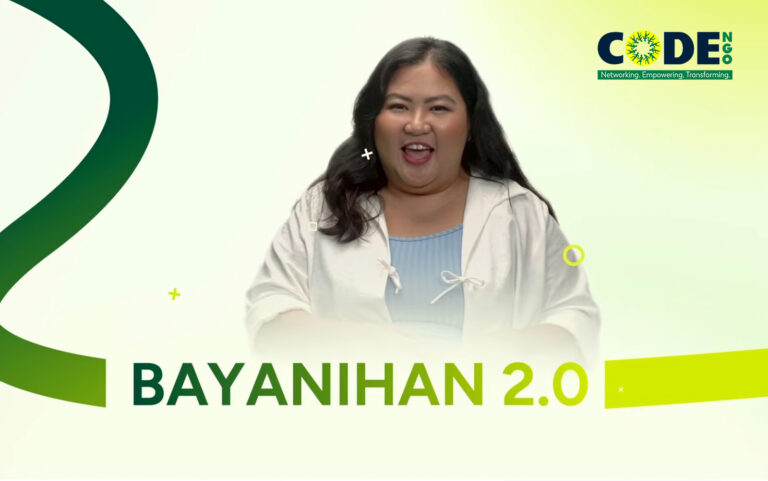
Bayanihan 2.0: CSO as Bantay, Katuwang and Boses | CODE-NGO Explainer
Bayanihan may have once meant carrying a house together, but it has since transformed to collective action towards addressing the needs of our communities and our nation. Discover “Bayanihan 2.0” and the role of Civil Society Organizations as the Katuwang, Bantay, at Boses of the Filipino people.
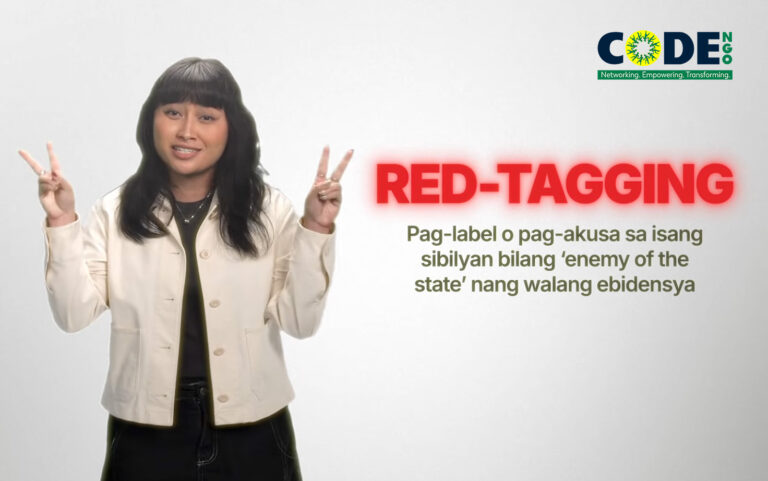
Gaano kadelikado ang red-tagging? | CODE-NGO Explainer
When speaking up on issues affecting our communities leads to being labeled as an enemy of the state, the line between advocate and combatant blurs.