
News & Stories.
News
Civil Society’s Decline and Post-2022 Elections
With partner organizations, CODE-NGO filed a petition at the Supreme Court against the Anti-Terrorism Act of 2020 The Philippines, lauded as the “oldest democracy in Asia”, boasts of historically having the strongest civil society in the region. Referring to the politically active sector of the general public, the country’s civil society is composed of a wide range of non-government organizations, people’s organizations, faith-based charities, social movements, and individual professionals and volunteers. Working with the marginalized sectors, a robust and thriving civil society helps drive a country’s development programs, advocates for policy changes, and seeks state accountability. During the Duterte administration,
COVID-proofing the 2022 National and Local Elections
With fluctuating COVID-19 cases in recent months, the May 2022 Philippine national elections will still need to be conducted under pandemic conditions. In a policy research paper, the Ateneo School of Government (ASOG) estimates that the Philippines needs to allocate PhP 17.5 billion additional funds to COVID-proof the elections. It also sets the parameters for holding safe, free, and fair elections, given the government’s pandemic management response and its challenges. As we near the elections, it is crucial to understand the Commission on Elections (COMELEC) plan in safeguarding the health and safety of voters as they exercise their right to
Mulat, Handa, at Alertayo!
Ilang buwan na lang bago ang 2022 National and Local Elections, ngunit samu’t saring isyu pa rin ang ating kinakaharap. Hindi pa kasama dito ang mga problemang lulutasin ng susunod na administrasyon. Anu-ano nga ba ang mga isyu na ito, at ano ang maaari nating gawin?We are pleased to invite you to “MULAT, HANDA, at ALERTayo: A National Forum on the 2022 Elections and a presentation of a PH Development Agenda” on March 30-31, 10AM to 12NN, via Zoom! Mag-register sa link na ito upang i-confirm ang iyong attendance: bit.ly/ALERTayoFORUM. Kitakits!
New Policies for the Better Normal
In response to the challenging times, the CODE-NGO secretariat took the time to review, develop, and improve organizational policies to continue its mission of providing quality services and programs to its staff, members, and partners under this new normal. In October 2021, the Board of Trustees approved two critical policies: digital security and digital safety. These policies establish clear guidelines and procedures for ensuring the protection of personal and organizational use of devices and the use of information under CODE-NGO’s custody. Furthermore, the secretariat enhanced its Service Continuity Plan (SCP), which defines its ability to continue providing services in the
Development and Reform Agenda (DRA) 2022-2028
Ensuring empowerment, democratization, and governance, along with peace and human rights, are themes found in the Development and Reform Agenda for 2022 – 2028 (DRA)*. The DRA and the process of agenda-building traces its roots in the 2010 elections. In 2009, in the midst of a global economic crisis, mal-governance across all levels of the country and clockwork devastation brought about by extreme climate change, CODE-NGO and many other CSOs put forward a DRA identifying priority actions in the hope that these will guide the succeeding administration in steering the country towards democratization and development. This DRA was based on
Increasing the Voice of the Non-Government Sectors in the OGP Platform
The Open Government Partnership (OGP) principles and values should go beyond its National Action Plan (NAP). These should be realized and promoted at all levels of government. This statement is the genuine change we seek.” This statement from the Philippine-OGP Non- Government Steering Committee Chairperson Andrea Maria Patricia Sarenas demonstrates the true clamor for genuine citizen participation in the OGP processes in all forms. In 2021, the non-government sectors increased their voice and maximized their presence to influence the government in promoting the OGP values on transparency, accountability, and participation in implementing programs and plans. The PH Non-Government Steering Committee
Features
Covid-19 Road to Recovery: Solutions from the Communities (2)
By: Albert Aquino, CENVISNET Synthesis of the public forum on September 24, 2020 during the CODE-NGO Social Development Week with the same title/theme; presented by Mr. Albert Aquino, Chairperson of CODE-NGO, 2018-2020 We acknowledge and value the recognition that our Honorable Vice President Leni Robredo gives to the work of CSOs, of CODE-NGO, its members and partners during this difficult time. Her recognition strengthens our resolve. “We are made for times like this!” she reminds us confidently. Indeed we are! The presentations of Bro. Armin Luistro, FSC and Dr. Jing Karaos give us more courage. Here are some points I
COVID-19 Road to Recovery: Solutions from the Communities (1)
By: Cristina Segnaken-Aban, CORDNET Highlights of members’ initiatives discussed during the CODE-NGO Social Development Week, September 21-24, 2020, presented by Ms. Cristina Aban, President of the Cordillera Network of NGOs and POs (CORDNET) Naimbag nga malem kadatayo amin! Good afternoon. The Corona Virus has affected all of us since March of this year until today. The Philippines has, to date, 294,951 accumulated positive cases of Covid-19 and 5,091 accumulated deaths. We have yet to flatten the proverbial curve. Meanwhile, during the community quarantine we witnessed the economy slowing down, jobs that were lost, and hunger experienced by many, among other
Food Security: Impacts and Innovations in the Time of Pandemic
by: Jennifer de Belen, Deanie Lyn Ocampo, and Sheena Pena Photo courtesy of: Bukluran Market The government imposition of community quarantine due to the Covid-19 pandemic has not only limited the mobility of people but also the movement of goods, especially food. Given the archipelagic nature of our country and our first experience of this kind of emergency, our agricultural-food system is definitely strained, not to mention that it has been confronting challenges even before the pandemic. How did government, civil society organizations, and farmers plow through these past months to make food available and accessible to us? FAO Philippines
Press Release
Statetement – PH dev’t NGOs: Take people power to local communities as nation commemorates EDSA uprising
The Caucus of Development Non-Government Organization Networks (CODE-NGO) enjoins the Filipino public to keep the spirit of the 1986 EDSA Uprising alive by putting ordinary people at the front and center of local development and of local autonomy – ideals, among many others, that figure prominently in the 1987 Constitution, as they facilitate the fulfillment of the rights and freedoms restored by this ongoing democratic project.
Statement: PH dev’t NGOs deeply concerned over alleged signature buying for Cha-Cha Push
The Caucus of Development Non-Government Organization Networks (CODE-NGO) is deeply concerned with the reports of alleged bribery by some officials in their effort to launch a people’s initiative and mobilize support for charter change.
#LakasLokal: PH dev’t CSOs celebrate Community Dev’t Week, call for wider civic spaces for local development workers
The Caucus of Development Non-Government Organization Networks (CODE-NGO) joins the nation in observing and celebrating this year’s Community Development Week and Community Development Day. This occasion recognizes the importance of community organization and the power of collective action towards local development.
Multimedia
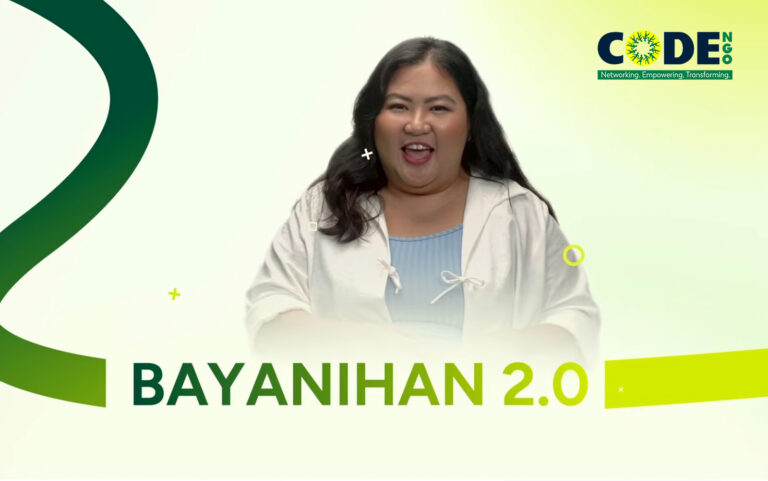
Bayanihan 2.0: CSO as Bantay, Katuwang and Boses | CODE-NGO Explainer
Bayanihan may have once meant carrying a house together, but it has since transformed to collective action towards addressing the needs of our communities and our nation. Discover “Bayanihan 2.0” and the role of Civil Society Organizations as the Katuwang, Bantay, at Boses of the Filipino people.
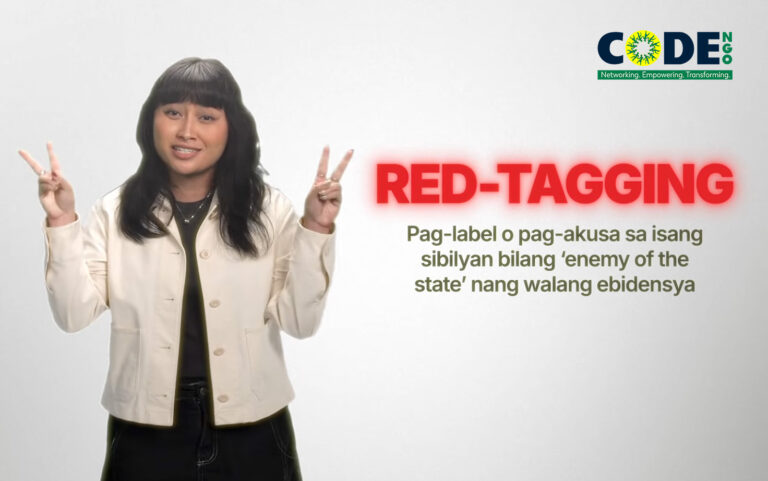
Gaano kadelikado ang red-tagging? | CODE-NGO Explainer
When speaking up on issues affecting our communities leads to being labeled as an enemy of the state, the line between advocate and combatant blurs.