News & Stories.
News
Network Strengthening: Towards Organizational and Financial Sustainability for Member Networks
In the second year of the pandemic, CODE-NGO continued to implement and provide capacity building interventions and initiatives to its member networks and member base organizations for them to better cope with the ongoing adversity and to be more accountable and effective civil society organizations. These strategic initiatives were moderated by the Commission on Institution and Capacity Building (CICB) and the Commission on Internal Reform Initiatives (CIRI). Sustainability Support Fund (SSF) 2021 for the Member Networks In May 2021, the CODE-NGO Board of Trustees approved the PhP 1.6M SSF grant to 10 member networks to support their financial sustainability initiatives
ALERTayo: Voters’ Rights Education and Electoral Reform Planning
The upcoming 2022 national and local elections are going to be a highly demanding test of the Philippine state of democracy. Election day, May 9, 2022, and its outcomes will reflect the integrity of the electoral process. In addition, integrity will also be enhanced in the pre-election preparations through collaboration by civil society organizations, individuals, and other democratic institutions. As 2022 draws near, Filipinos are looking for more ways to contribute to ensuring a safe and honest election. In line with this, the Initiatives for Dialogue and Empowerment through Alternative Legal Services, Inc. (IDEALS) and the Caucus of Development NGO
Profiling Extremely Poor Families in Camotes Island
Last September 2021, the Zero Extreme Poverty Philippines 2030 (ZEP2030) Cebu Local Convergence Team, composed of the Central Visayas Network of NGOs (CENVISNET) and the A2D Project, traveled nine (9) hours to reach Camotes Island in the northeast part of the province of Cebu. Camotes Island is a ZEP2030 area where civil society, business, and academe will converge efforts for poverty alleviation in the area. Camotes Island has a population of 102,996 individuals (2015 Census) with a poverty incidence of 38.4%. Fishing and local tourism are the primary sources of livelihood for the locals. The team conducted a series of
Let’s Go! CODE-NGO e-Tour Sessions
With the theme “Network, Empower, Transform: Our Response to Effective Social Change,” the Social Development Week (SocDev) 2021 offers CODE-NGO members and the wider CSO community a half-year series of learning and influencing using new ways to network, empower, and transform in order to achieve effective social change. Learning from other CSOs by traveling to their provinces or communities is an impressionable, reiterative, and encouraging teaching-learning method for people of all ages. But because of our mobility restrictions and community quarantines, we offer instead a series of online peer learning exchanges through the e-Tour Sessions. The goal of the e-Tour
Features
Remembering Leaders of CODE-NGO
CODE-NGO paid tribute to its former leaders who have passed on in recent years. With unwavering tenacity, they helped shape CODE-NGO to the coalition that it is today. Karina Constantino-David was the Chairperson of CODE-NGO from 1990-1998. Karina was also a great and respected leader in the academe, government, and civil society. In 1980, Karina drew a “map” of the Philippine NGO terrain, categorizing NGOs into three basic types: non-government individuals, membership-based organizations, and institutions. She was professor and head of University of the Philippines-Diliman’s Department of Community Development. After serving the government for over three decades – as Department
Marissa Camacho: Rest Now In God’s Peace
“If you’re just alone (not a member of any network), you only know your own program, the people you are working with and the areas you are operating in. But if you’re part of a network, you get to know other organizations and what they are doing, the issues they are working on and learn from their experiences. You also get exposed to the broader development community including donors. It can lead to partnerships with other organizations leading to synergies of efforts. Members of networks are also introduced to national issues which are not necessarily their issues, contributing to better
Dagyaw 2020 Opens Safe Space and Dialogue for the Public
CODE-NGO and its members are taking an active part in the Dagyaw 2020. Since 2018, the Participatory Governance Cluster of the Cabinet (PGC) has been spearheading annual regional town hall meetings attended by people from both the government and non-government sector. In 2019, by virtue of PGC Resolution No. 02-S2019, these town hall meetings were re-launched as Dagyaw: Open Government and Participatory Governance Regional Town Hall Meetings. Dagyaw is a Hiligaynon term for “Bayanihan,” which highlights the concept of togetherness. Dagyaw fully captures the very nature and value proposition of town hall meetings where government offices, non-government organizations, businesses, and
Press Release
Statetement – PH dev’t NGOs: Take people power to local communities as nation commemorates EDSA uprising
The Caucus of Development Non-Government Organization Networks (CODE-NGO) enjoins the Filipino public to keep the spirit of the 1986 EDSA Uprising alive by putting ordinary people at the front and center of local development and of local autonomy – ideals, among many others, that figure prominently in the 1987 Constitution, as they facilitate the fulfillment of the rights and freedoms restored by this ongoing democratic project.
Statement: PH dev’t NGOs deeply concerned over alleged signature buying for Cha-Cha Push
The Caucus of Development Non-Government Organization Networks (CODE-NGO) is deeply concerned with the reports of alleged bribery by some officials in their effort to launch a people’s initiative and mobilize support for charter change.
#LakasLokal: PH dev’t CSOs celebrate Community Dev’t Week, call for wider civic spaces for local development workers
The Caucus of Development Non-Government Organization Networks (CODE-NGO) joins the nation in observing and celebrating this year’s Community Development Week and Community Development Day. This occasion recognizes the importance of community organization and the power of collective action towards local development.
Multimedia
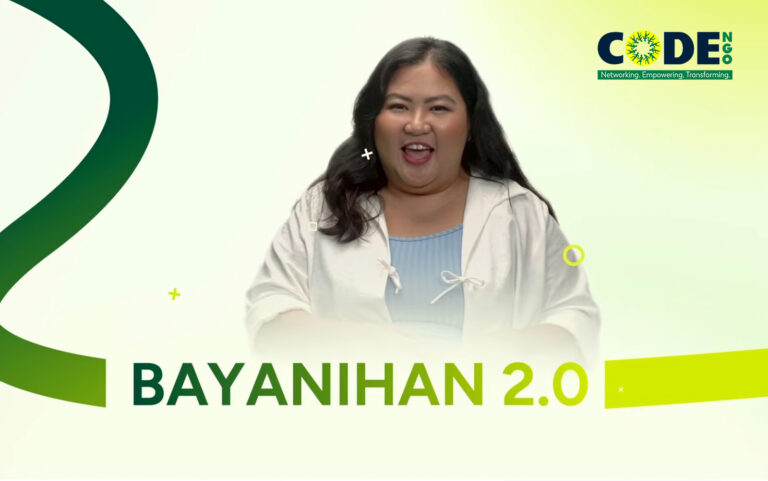
Bayanihan 2.0: CSO as Bantay, Katuwang and Boses | CODE-NGO Explainer
Bayanihan may have once meant carrying a house together, but it has since transformed to collective action towards addressing the needs of our communities and our nation. Discover “Bayanihan 2.0” and the role of Civil Society Organizations as the Katuwang, Bantay, at Boses of the Filipino people.
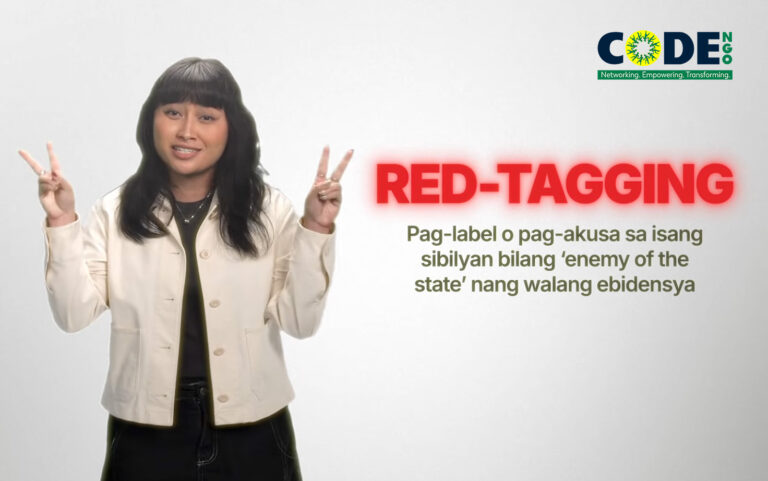
Gaano kadelikado ang red-tagging? | CODE-NGO Explainer
When speaking up on issues affecting our communities leads to being labeled as an enemy of the state, the line between advocate and combatant blurs.