News & Stories.
News
Civil Society’s Decline and Post-2022 Elections
With partner organizations, CODE-NGO filed a petition at the Supreme Court against the Anti-Terrorism Act of 2020 The Philippines, lauded as the “oldest democracy in Asia”, boasts of historically having the strongest civil society in the region. Referring to the politically active sector of the general public, the country’s civil society is composed of a wide range of non-government organizations, people’s organizations, faith-based charities, social movements, and individual professionals and volunteers. Working with the marginalized sectors, a robust and thriving civil society helps drive a country’s development programs, advocates for policy changes, and seeks state accountability. During the Duterte administration,
COVID-proofing the 2022 National and Local Elections
With fluctuating COVID-19 cases in recent months, the May 2022 Philippine national elections will still need to be conducted under pandemic conditions. In a policy research paper, the Ateneo School of Government (ASOG) estimates that the Philippines needs to allocate PhP 17.5 billion additional funds to COVID-proof the elections. It also sets the parameters for holding safe, free, and fair elections, given the government’s pandemic management response and its challenges. As we near the elections, it is crucial to understand the Commission on Elections (COMELEC) plan in safeguarding the health and safety of voters as they exercise their right to
Mulat, Handa, at Alertayo!
Ilang buwan na lang bago ang 2022 National and Local Elections, ngunit samu’t saring isyu pa rin ang ating kinakaharap. Hindi pa kasama dito ang mga problemang lulutasin ng susunod na administrasyon. Anu-ano nga ba ang mga isyu na ito, at ano ang maaari nating gawin?We are pleased to invite you to “MULAT, HANDA, at ALERTayo: A National Forum on the 2022 Elections and a presentation of a PH Development Agenda” on March 30-31, 10AM to 12NN, via Zoom! Mag-register sa link na ito upang i-confirm ang iyong attendance: bit.ly/ALERTayoFORUM. Kitakits!
New Policies for the Better Normal
In response to the challenging times, the CODE-NGO secretariat took the time to review, develop, and improve organizational policies to continue its mission of providing quality services and programs to its staff, members, and partners under this new normal. In October 2021, the Board of Trustees approved two critical policies: digital security and digital safety. These policies establish clear guidelines and procedures for ensuring the protection of personal and organizational use of devices and the use of information under CODE-NGO’s custody. Furthermore, the secretariat enhanced its Service Continuity Plan (SCP), which defines its ability to continue providing services in the
Development and Reform Agenda (DRA) 2022-2028
Ensuring empowerment, democratization, and governance, along with peace and human rights, are themes found in the Development and Reform Agenda for 2022 – 2028 (DRA)*. The DRA and the process of agenda-building traces its roots in the 2010 elections. In 2009, in the midst of a global economic crisis, mal-governance across all levels of the country and clockwork devastation brought about by extreme climate change, CODE-NGO and many other CSOs put forward a DRA identifying priority actions in the hope that these will guide the succeeding administration in steering the country towards democratization and development. This DRA was based on
Increasing the Voice of the Non-Government Sectors in the OGP Platform
The Open Government Partnership (OGP) principles and values should go beyond its National Action Plan (NAP). These should be realized and promoted at all levels of government. This statement is the genuine change we seek.” This statement from the Philippine-OGP Non- Government Steering Committee Chairperson Andrea Maria Patricia Sarenas demonstrates the true clamor for genuine citizen participation in the OGP processes in all forms. In 2021, the non-government sectors increased their voice and maximized their presence to influence the government in promoting the OGP values on transparency, accountability, and participation in implementing programs and plans. The PH Non-Government Steering Committee
Features
Communities Co-operating and Thriving During Tight Times
By: Deanie Lyn Ocampo and Sheena Pena Republic Act No. 11469 or “Bayanihan to Heal as One Act” was signed into law on March 23, 2020 by President Duterte declaring a national health emergency throughout the Philippines as a result of the COVID-19 situation. It provides, among others, that all lenders apply the 30-day mandatory grace period for loans falling due within the period of the Enhanced Community Quarantine (ECQ), which was extended until May 31, 2020. With that provision, how did three cooperatives thrive during the ECQ and continue to flourish during this pandemic? Baao Parish Multipurpose Cooperative in
The Humanitarian Way: Mental Health Support amidst the Pandemic
By: Jennifer de Belen and Sheena Peña The COVID-19 pandemic is affecting people’s mental and emotional wellness as media updates abound every day and their actions are constrained by the situation. Our front liners are not spared; in fact, they are more affected psychologically. They are put in risk to save the lives of others, yet they are discriminated against and treated undesirably by some people. How did humanitarian NGOs, private institutions, and community groups collaborate to provide mental health and wellbeing support to frontliners? The Wellbeing Cluster PH is an off-shoot network of humanitarian response of the Central
Live at Komunikamp!
Communication, as we define it, is the process of imparting or exchanging information and/or messages. But as easy as it sounds, it is also something that many of us, individual and organization alike, lack in many aspects. In our modern world, communication is becoming all the more important for us to understand what is going on around us and how we respond to it. Today, clamor for transparency, accountability, and access to information is stronger than ever. That is why communication is necessary in many organizations. Civil Society Organizations (CSOs) whose mandate is to do humanitarian work need to ensure
Press Release
Transparency, COMELEC!
The public trusted that the COMELEC will safeguard the electoral process. However, the poorly explained technical glitches – around 600 vote counting machines (VCMs) that malfunctioned; 1,000 corrupted SD cards and the 7-hour data outage of the COMELEC transparency server on May 13 due to Java error – are casting doubts on the credibility of the election results. Further, the secrecy of the location of the COMELEC central server, its back-up and what is called as the ‘transmission router’ are making the electoral processes clouded rather than transparent. The way COMELEC is managing the electoral processes seem like a regression
CHLI to Philippine Cooperatives: Why Business Continuity Management is Important
(Photo source: Faceboook) The Center for Humanitarian Learning and Innovation (CHLI) Director Dong Waña was invited to act as resource person on Business Continuity Management (BCM) for Cooperatives during the Bicol Regional Cooperative Congress 2019. Organized by the Masbate Provincial Cooperative Development Council, Masbate City Cooperative Development Council, Cooperative Union of Masbate and Masbate City LGU in partnership with the Regional Cooperative Development Council and Cooperative Development Authority (CDA), the congress was held in Masbate City on April 10-11, 2019 with the theme “Pag Solbar San Kapobrehan, Kooperatiba an Kaipuhan (To Solve Poverty, Cooperatives are Needed)”. Around 350 representatives from
CODE-NGO Leads Humanitarian Learning and Innovation in the Philippines
February 14 -15, 2019—CODE-NGO met with Business Operations Director Nicolas Kröger and Head of Partnerships Alex Farrington of the Humanitarian Leadership Academy (HLA) to formalize the founding of the Center for Humanitarian Learning and Innovation (CHLI) in the Philippines. CHLI is a joint initiative between CODE-NGO and HLA which aims to address the capacity development needs of individuals and institutions operating in the humanitarian sector. As the exclusive affiliate of the Academy in the Philippines, CODE-NGO, through CHLI, is set to take the lead in user-centric design approaches to address the growing demand for a highly skilled humanitarian workforce. With
Multimedia
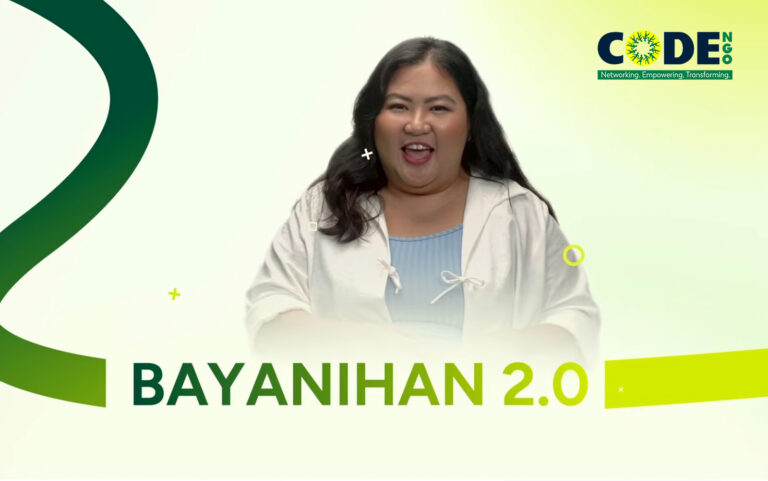
Bayanihan 2.0: CSO as Bantay, Katuwang and Boses | CODE-NGO Explainer
Bayanihan may have once meant carrying a house together, but it has since transformed to collective action towards addressing the needs of our communities and our nation. Discover “Bayanihan 2.0” and the role of Civil Society Organizations as the Katuwang, Bantay, at Boses of the Filipino people.
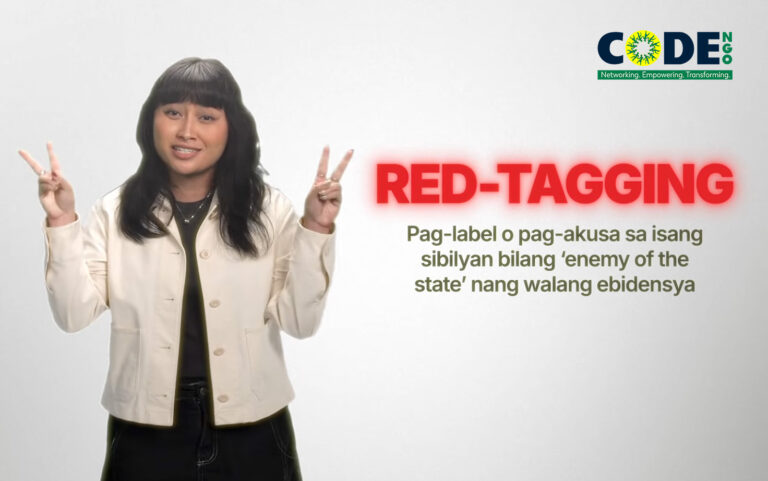
Gaano kadelikado ang red-tagging? | CODE-NGO Explainer
When speaking up on issues affecting our communities leads to being labeled as an enemy of the state, the line between advocate and combatant blurs.