
News & Stories.
News

Lakas Lokal 2.0: CODE-NGO Holds 35th GA, SocDev Celebration to Confront Corruption, Shrinking Civic Space; Elects New Board
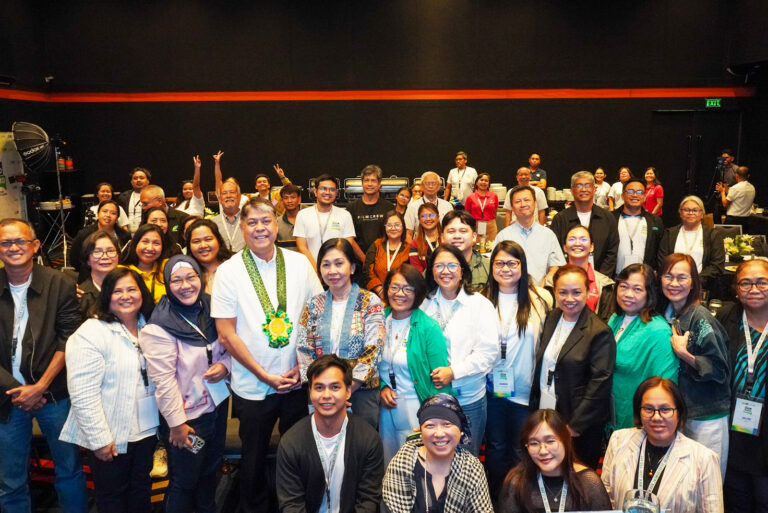
Civil society leaders, development workers, and partner organizations convened at the B Hotel, Quezon City on June 29–30, 2026, for the 35th General Assembly and Social Development Celebration of the Caucus of Development NGO Networks (CODE-NGO).
Sponsor: Ramon Aboitiz Foundation, Inc.
The Ramon Aboitiz Foundation (RAFI) is a non-stock, non-profit organization (SEC Registration 31083) established in 1966 by Don Ramon Aboitiz. It is accredited by the Philippine Council for NGO Certification (PCNC no. 021-2020) and a member of the Association of Foundations.
CODE-NGO’s Social Development Week 2022 and 7th Congress
With the theme “Magpakahusay: Strengthening Civil Society to Level Up Democracy”, CODE-NGO will be holding its annual Social Development Week and 7th Congress on October 24-28, 2022 via Zoom and Facebook Live.
“Pagmuni-muni” (“Reflections”): Post-Election Discussion Series
By: Lenbi Laborte, CENVISNET The Central Visayas Network of NGOs (CENVISNET), a coalition of civil society organization (CSO) networks in Cebu, Bohol, and Negros Oriental (Region VII), conducted its first round of post-election focused group discussions entitled “Pagmuni-muni” with CSOs, the private sector, academe, and media last June 2022. Mr. Sandino Soliman, Program Officer for Advocacy of CODE-NGO, graced the series by providing an overview of the PARTICIPATE project and coalition, highlighting the role of CSOs in electoral process and reform through voters’ education and information drive, constituent mobilization and agenda building, policy lobbying and advocacy, and monitoring of the
CODE-NGO Joins Advocacy for Electoral Reforms
The Caucus of Development NGO Networks (CODE-NGO) passed a resolution at its 31st General Assembly last May 27, 2022 to advocate for the Hybrid Election System to the Commission on Elections (COMELEC). The resolution, sponsored by its member network, Central Visayas Network of NGOs (CENVISNET), seeks to respond to the anomalies seen in the 2022 national and local elections. Journalists and independent observers such as the Philippine Election 2022 International Observers Mission spearheaded by the International Coalition for Human Rights in the Philippines reported anomalies – vote-counting machines (VCM) were broken down, SD memory cards needed to be replaced, and
CALL TO ACTION: Network. Empower. Transform. Our Response to Effective Social Change
Retired Senior Associate Justice of the Supreme Court of the Republic of the Philippines Antonio T. Carpio delivered the keynote address during SocDev 2021. Below is a transcript of his speech: Pleasant day to everyone. Thank you for inviting me to address you this afternoon. We meet online today at the worst of times. We face daunting challenges we have never faced before in the last 75 years. The pandemic has debilitated our economy with at least 50% of SMEs having closed down. We have one of the longest lockdowns in the world, resulting in the steepest contraction of our
Features
Profiling CODE-NGO’s 1,614 Member Organizations
The CODE-NGO membership database (as of 2017) encompasses 1,614 member-base organizations (MBOs) located in 79 provinces and 43 highly urbanized and independent component cities. The database contains the MBOs’ contact details, location, accreditation by LGUs, membership in local special bodies, core programs, primary beneficiaries, means of communication, etc. To facilitate data analysis, we designed a frequency table according to Primary-level Subdivisions of Local Government Units. Information on our MBOs may be filtered by (1) location, (2) membership in networks, (3) type of organization, (4) accreditation by the Sangguniang Bayan, Panlungsod or Panlalawigan, and membership in Local Development Councils (LDCs), Local
Local CSO’s Accreditation 2019 – A Marked Difference
This year’s round of accreditation of civil society organizations (CSOs) in the local Sanggunian has an important activity added to the usual activities being done every time after Philippine elections take place. At the start of the three-year term of local officials, in this case the mayors, vice-mayors and the city or municipal councilors, a process of accreditation and reconstitution of local special bodies (LSBs) will be called by the local government unit (LGU) and guided by the Department of Interior and Local Government (DILG). CSOs may apply for accreditation to the LGU where they are located. The accredited CSOs
Localization is the Key!
Two years since it was founded, the Zero Extreme Poverty (ZEP) 2030 Movement is faced with the challenge of reaching its original target of helping uplift 1 million families from extreme poverty by 2030. To date, it has mapped 16,000 families and has a presence in 70 municipalities, far from its target of covering 350 municipalities with 10 years left. Last August, the movement’s lead convenors and key local partners went into a retreat to reflect and re-strategize, with the support of the United Nations Development Programme (UNDP) Accelerator Lab initiative. CODE-NGO and member networks Philippine Business for Social Progress
Press Release
Press Statement: PH dev’t NGOs bat for people-centered climate action and disaster response
The Caucus of Development NGO Networks (CODE NGO) is one with the nation in commemorating the 10th anniversary of the onslaught of Super Typhoon Yolanda, one of the most powerful and deadliest tropical cyclones in history. Today, we remember and honor those who perished amidst this unprecedented tragedy, as well as the families and friends they left behind.
Filipinos, Demand Accountability!
We, the Caucus of Development NGO Networks (CODE-NGO), representing 1,600 non-government organizations, people’s organizations, and cooperatives nationwide, call on our fellow Filipinos to demand accountability from government and support democratic institutions such as the Commission on Audit (COA) and its mission “to ensure accountability for public resources, promote transparency, and help improve government operations, in partnership with stakeholders, for the benefit of the Filipino people.” The national and local governments are accountable to us, citizens, for the management and judicious use of all resources – people, supplies, property, and public funds. The chief of every government agency or unit and
DILG MC 2021-12: Imposing Restrictions on People’s Participation
We, the undersigned civil society organizations (CSOs), are deeply disturbed by the Memorandum Circular (MC) 2021-012 released by the Department of Interior and Local Government (DILG). Section 4.1 of the MC explicitly states that CSOs should acquire clearance from both the Armed Forces of the Philippines (AFP) and the Philippine National Police (PNP) to participate in the governance of their local government units (LGUs). The clearance “shall indicate that such CSO is cleared from any subversive and illegal activities.” We question and oppose this provision given the following: A clearance from the AFP and PNP as a prerequisite for CSOs
Multimedia

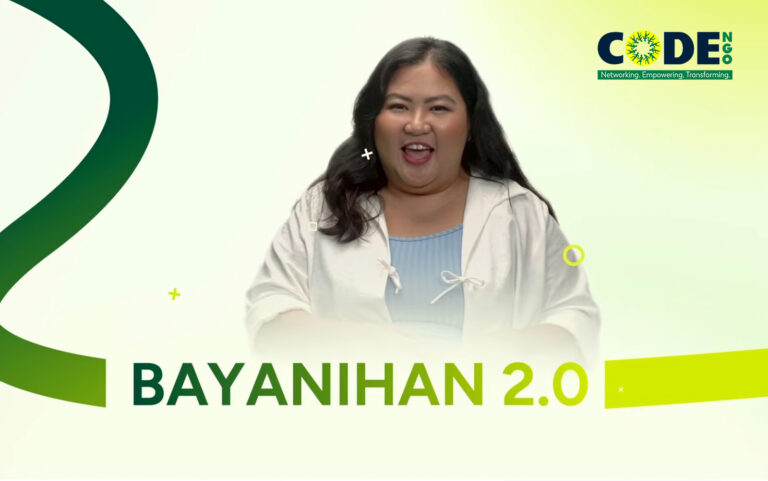
Bayanihan 2.0: CSO as Bantay, Katuwang and Boses | CODE-NGO Explainer
Bayanihan may have once meant carrying a house together, but it has since transformed to collective action towards addressing the needs of our communities and our nation. Discover “Bayanihan 2.0” and the role of Civil Society Organizations as the Katuwang, Bantay, at Boses of the Filipino people.
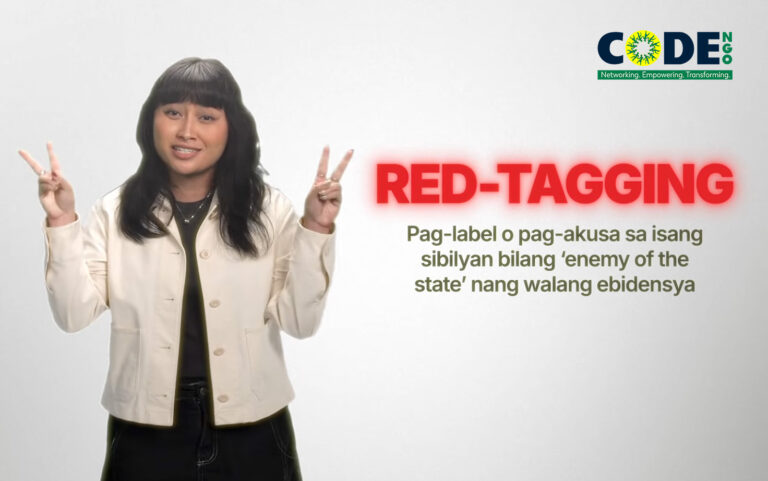
Gaano kadelikado ang red-tagging? | CODE-NGO Explainer
When speaking up on issues affecting our communities leads to being labeled as an enemy of the state, the line between advocate and combatant blurs.