News & Stories.
News
Network Strengthening: Towards Organizational and Financial Sustainability for Member Networks
In the second year of the pandemic, CODE-NGO continued to implement and provide capacity building interventions and initiatives to its member networks and member base organizations for them to better cope with the ongoing adversity and to be more accountable and effective civil society organizations. These strategic initiatives were moderated by the Commission on Institution and Capacity Building (CICB) and the Commission on Internal Reform Initiatives (CIRI). Sustainability Support Fund (SSF) 2021 for the Member Networks In May 2021, the CODE-NGO Board of Trustees approved the PhP 1.6M SSF grant to 10 member networks to support their financial sustainability initiatives
ALERTayo: Voters’ Rights Education and Electoral Reform Planning
The upcoming 2022 national and local elections are going to be a highly demanding test of the Philippine state of democracy. Election day, May 9, 2022, and its outcomes will reflect the integrity of the electoral process. In addition, integrity will also be enhanced in the pre-election preparations through collaboration by civil society organizations, individuals, and other democratic institutions. As 2022 draws near, Filipinos are looking for more ways to contribute to ensuring a safe and honest election. In line with this, the Initiatives for Dialogue and Empowerment through Alternative Legal Services, Inc. (IDEALS) and the Caucus of Development NGO
Profiling Extremely Poor Families in Camotes Island
Last September 2021, the Zero Extreme Poverty Philippines 2030 (ZEP2030) Cebu Local Convergence Team, composed of the Central Visayas Network of NGOs (CENVISNET) and the A2D Project, traveled nine (9) hours to reach Camotes Island in the northeast part of the province of Cebu. Camotes Island is a ZEP2030 area where civil society, business, and academe will converge efforts for poverty alleviation in the area. Camotes Island has a population of 102,996 individuals (2015 Census) with a poverty incidence of 38.4%. Fishing and local tourism are the primary sources of livelihood for the locals. The team conducted a series of
Let’s Go! CODE-NGO e-Tour Sessions
With the theme “Network, Empower, Transform: Our Response to Effective Social Change,” the Social Development Week (SocDev) 2021 offers CODE-NGO members and the wider CSO community a half-year series of learning and influencing using new ways to network, empower, and transform in order to achieve effective social change. Learning from other CSOs by traveling to their provinces or communities is an impressionable, reiterative, and encouraging teaching-learning method for people of all ages. But because of our mobility restrictions and community quarantines, we offer instead a series of online peer learning exchanges through the e-Tour Sessions. The goal of the e-Tour
Features
Covid-19 Road to Recovery: Solutions from the Communities (2)
By: Albert Aquino, CENVISNET Synthesis of the public forum on September 24, 2020 during the CODE-NGO Social Development Week with the same title/theme; presented by Mr. Albert Aquino, Chairperson of CODE-NGO, 2018-2020 We acknowledge and value the recognition that our Honorable Vice President Leni Robredo gives to the work of CSOs, of CODE-NGO, its members and partners during this difficult time. Her recognition strengthens our resolve. “We are made for times like this!” she reminds us confidently. Indeed we are! The presentations of Bro. Armin Luistro, FSC and Dr. Jing Karaos give us more courage. Here are some points I
COVID-19 Road to Recovery: Solutions from the Communities (1)
By: Cristina Segnaken-Aban, CORDNET Highlights of members’ initiatives discussed during the CODE-NGO Social Development Week, September 21-24, 2020, presented by Ms. Cristina Aban, President of the Cordillera Network of NGOs and POs (CORDNET) Naimbag nga malem kadatayo amin! Good afternoon. The Corona Virus has affected all of us since March of this year until today. The Philippines has, to date, 294,951 accumulated positive cases of Covid-19 and 5,091 accumulated deaths. We have yet to flatten the proverbial curve. Meanwhile, during the community quarantine we witnessed the economy slowing down, jobs that were lost, and hunger experienced by many, among other
Food Security: Impacts and Innovations in the Time of Pandemic
by: Jennifer de Belen, Deanie Lyn Ocampo, and Sheena Pena Photo courtesy of: Bukluran Market The government imposition of community quarantine due to the Covid-19 pandemic has not only limited the mobility of people but also the movement of goods, especially food. Given the archipelagic nature of our country and our first experience of this kind of emergency, our agricultural-food system is definitely strained, not to mention that it has been confronting challenges even before the pandemic. How did government, civil society organizations, and farmers plow through these past months to make food available and accessible to us? FAO Philippines
Press Release
Press Statement: PH dev’t NGOs bat for people-centered climate action and disaster response
The Caucus of Development NGO Networks (CODE NGO) is one with the nation in commemorating the 10th anniversary of the onslaught of Super Typhoon Yolanda, one of the most powerful and deadliest tropical cyclones in history. Today, we remember and honor those who perished amidst this unprecedented tragedy, as well as the families and friends they left behind.
Filipinos, Demand Accountability!
We, the Caucus of Development NGO Networks (CODE-NGO), representing 1,600 non-government organizations, people’s organizations, and cooperatives nationwide, call on our fellow Filipinos to demand accountability from government and support democratic institutions such as the Commission on Audit (COA) and its mission “to ensure accountability for public resources, promote transparency, and help improve government operations, in partnership with stakeholders, for the benefit of the Filipino people.” The national and local governments are accountable to us, citizens, for the management and judicious use of all resources – people, supplies, property, and public funds. The chief of every government agency or unit and
DILG MC 2021-12: Imposing Restrictions on People’s Participation
We, the undersigned civil society organizations (CSOs), are deeply disturbed by the Memorandum Circular (MC) 2021-012 released by the Department of Interior and Local Government (DILG). Section 4.1 of the MC explicitly states that CSOs should acquire clearance from both the Armed Forces of the Philippines (AFP) and the Philippine National Police (PNP) to participate in the governance of their local government units (LGUs). The clearance “shall indicate that such CSO is cleared from any subversive and illegal activities.” We question and oppose this provision given the following: A clearance from the AFP and PNP as a prerequisite for CSOs
Multimedia
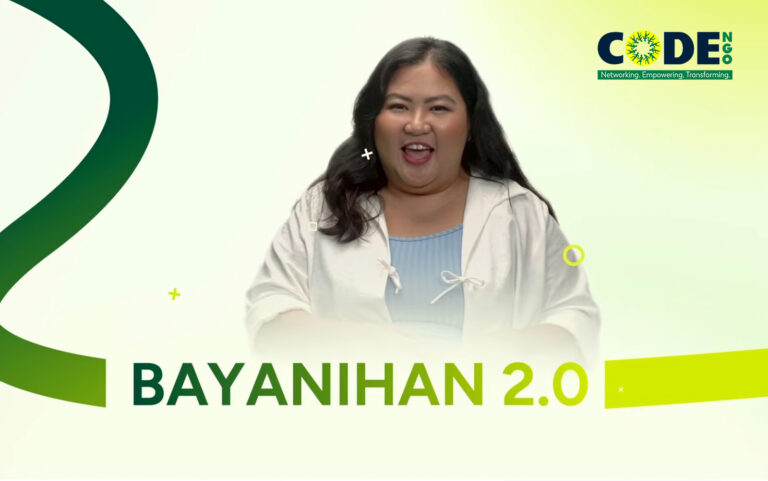
Bayanihan 2.0: CSO as Bantay, Katuwang and Boses | CODE-NGO Explainer
Bayanihan may have once meant carrying a house together, but it has since transformed to collective action towards addressing the needs of our communities and our nation. Discover “Bayanihan 2.0” and the role of Civil Society Organizations as the Katuwang, Bantay, at Boses of the Filipino people.
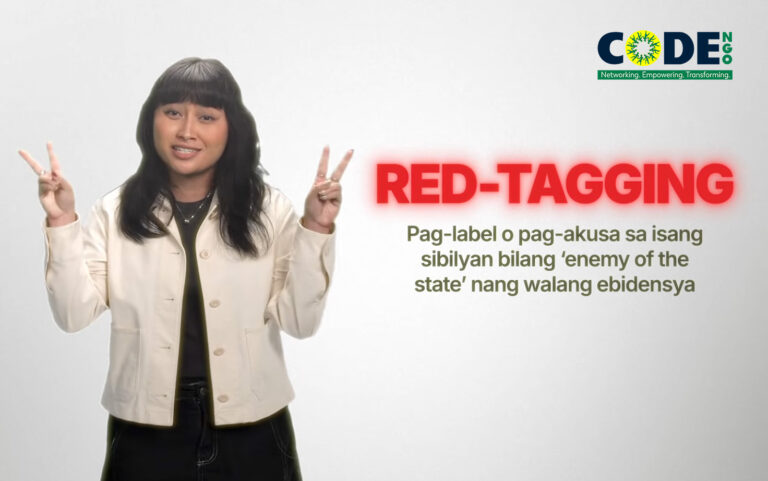
Gaano kadelikado ang red-tagging? | CODE-NGO Explainer
When speaking up on issues affecting our communities leads to being labeled as an enemy of the state, the line between advocate and combatant blurs.