News & Stories.
News
Civil Society’s Decline and Post-2022 Elections
With partner organizations, CODE-NGO filed a petition at the Supreme Court against the Anti-Terrorism Act of 2020 The Philippines, lauded as the “oldest democracy in Asia”, boasts of historically having the strongest civil society in the region. Referring to the politically active sector of the general public, the country’s civil society is composed of a wide range of non-government organizations, people’s organizations, faith-based charities, social movements, and individual professionals and volunteers. Working with the marginalized sectors, a robust and thriving civil society helps drive a country’s development programs, advocates for policy changes, and seeks state accountability. During the Duterte administration,
COVID-proofing the 2022 National and Local Elections
With fluctuating COVID-19 cases in recent months, the May 2022 Philippine national elections will still need to be conducted under pandemic conditions. In a policy research paper, the Ateneo School of Government (ASOG) estimates that the Philippines needs to allocate PhP 17.5 billion additional funds to COVID-proof the elections. It also sets the parameters for holding safe, free, and fair elections, given the government’s pandemic management response and its challenges. As we near the elections, it is crucial to understand the Commission on Elections (COMELEC) plan in safeguarding the health and safety of voters as they exercise their right to
Mulat, Handa, at Alertayo!
Ilang buwan na lang bago ang 2022 National and Local Elections, ngunit samu’t saring isyu pa rin ang ating kinakaharap. Hindi pa kasama dito ang mga problemang lulutasin ng susunod na administrasyon. Anu-ano nga ba ang mga isyu na ito, at ano ang maaari nating gawin?We are pleased to invite you to “MULAT, HANDA, at ALERTayo: A National Forum on the 2022 Elections and a presentation of a PH Development Agenda” on March 30-31, 10AM to 12NN, via Zoom! Mag-register sa link na ito upang i-confirm ang iyong attendance: bit.ly/ALERTayoFORUM. Kitakits!
New Policies for the Better Normal
In response to the challenging times, the CODE-NGO secretariat took the time to review, develop, and improve organizational policies to continue its mission of providing quality services and programs to its staff, members, and partners under this new normal. In October 2021, the Board of Trustees approved two critical policies: digital security and digital safety. These policies establish clear guidelines and procedures for ensuring the protection of personal and organizational use of devices and the use of information under CODE-NGO’s custody. Furthermore, the secretariat enhanced its Service Continuity Plan (SCP), which defines its ability to continue providing services in the
Development and Reform Agenda (DRA) 2022-2028
Ensuring empowerment, democratization, and governance, along with peace and human rights, are themes found in the Development and Reform Agenda for 2022 – 2028 (DRA)*. The DRA and the process of agenda-building traces its roots in the 2010 elections. In 2009, in the midst of a global economic crisis, mal-governance across all levels of the country and clockwork devastation brought about by extreme climate change, CODE-NGO and many other CSOs put forward a DRA identifying priority actions in the hope that these will guide the succeeding administration in steering the country towards democratization and development. This DRA was based on
Increasing the Voice of the Non-Government Sectors in the OGP Platform
The Open Government Partnership (OGP) principles and values should go beyond its National Action Plan (NAP). These should be realized and promoted at all levels of government. This statement is the genuine change we seek.” This statement from the Philippine-OGP Non- Government Steering Committee Chairperson Andrea Maria Patricia Sarenas demonstrates the true clamor for genuine citizen participation in the OGP processes in all forms. In 2021, the non-government sectors increased their voice and maximized their presence to influence the government in promoting the OGP values on transparency, accountability, and participation in implementing programs and plans. The PH Non-Government Steering Committee
Features
Remembering Leaders of CODE-NGO
CODE-NGO paid tribute to its former leaders who have passed on in recent years. With unwavering tenacity, they helped shape CODE-NGO to the coalition that it is today. Karina Constantino-David was the Chairperson of CODE-NGO from 1990-1998. Karina was also a great and respected leader in the academe, government, and civil society. In 1980, Karina drew a “map” of the Philippine NGO terrain, categorizing NGOs into three basic types: non-government individuals, membership-based organizations, and institutions. She was professor and head of University of the Philippines-Diliman’s Department of Community Development. After serving the government for over three decades – as Department
Marissa Camacho: Rest Now In God’s Peace
“If you’re just alone (not a member of any network), you only know your own program, the people you are working with and the areas you are operating in. But if you’re part of a network, you get to know other organizations and what they are doing, the issues they are working on and learn from their experiences. You also get exposed to the broader development community including donors. It can lead to partnerships with other organizations leading to synergies of efforts. Members of networks are also introduced to national issues which are not necessarily their issues, contributing to better
Dagyaw 2020 Opens Safe Space and Dialogue for the Public
CODE-NGO and its members are taking an active part in the Dagyaw 2020. Since 2018, the Participatory Governance Cluster of the Cabinet (PGC) has been spearheading annual regional town hall meetings attended by people from both the government and non-government sector. In 2019, by virtue of PGC Resolution No. 02-S2019, these town hall meetings were re-launched as Dagyaw: Open Government and Participatory Governance Regional Town Hall Meetings. Dagyaw is a Hiligaynon term for “Bayanihan,” which highlights the concept of togetherness. Dagyaw fully captures the very nature and value proposition of town hall meetings where government offices, non-government organizations, businesses, and
Press Release
Press Statement: PH dev’t NGOs bat for people-centered climate action and disaster response
The Caucus of Development NGO Networks (CODE NGO) is one with the nation in commemorating the 10th anniversary of the onslaught of Super Typhoon Yolanda, one of the most powerful and deadliest tropical cyclones in history. Today, we remember and honor those who perished amidst this unprecedented tragedy, as well as the families and friends they left behind.
Filipinos, Demand Accountability!
We, the Caucus of Development NGO Networks (CODE-NGO), representing 1,600 non-government organizations, people’s organizations, and cooperatives nationwide, call on our fellow Filipinos to demand accountability from government and support democratic institutions such as the Commission on Audit (COA) and its mission “to ensure accountability for public resources, promote transparency, and help improve government operations, in partnership with stakeholders, for the benefit of the Filipino people.” The national and local governments are accountable to us, citizens, for the management and judicious use of all resources – people, supplies, property, and public funds. The chief of every government agency or unit and
DILG MC 2021-12: Imposing Restrictions on People’s Participation
We, the undersigned civil society organizations (CSOs), are deeply disturbed by the Memorandum Circular (MC) 2021-012 released by the Department of Interior and Local Government (DILG). Section 4.1 of the MC explicitly states that CSOs should acquire clearance from both the Armed Forces of the Philippines (AFP) and the Philippine National Police (PNP) to participate in the governance of their local government units (LGUs). The clearance “shall indicate that such CSO is cleared from any subversive and illegal activities.” We question and oppose this provision given the following: A clearance from the AFP and PNP as a prerequisite for CSOs
Multimedia
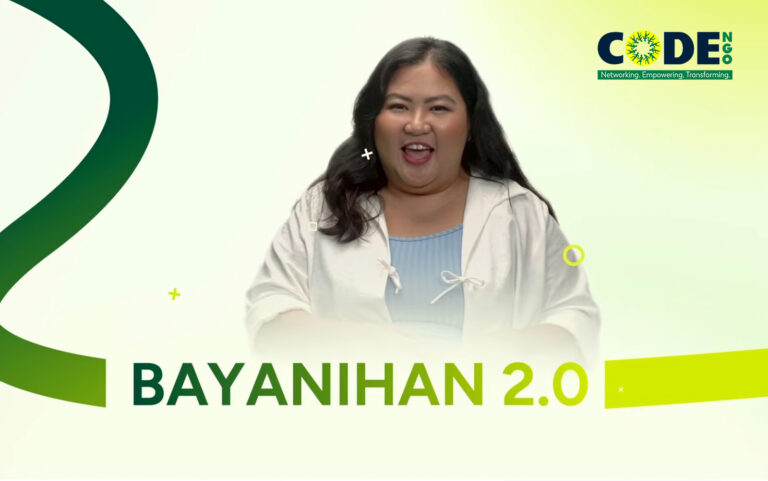
Bayanihan 2.0: CSO as Bantay, Katuwang and Boses | CODE-NGO Explainer
Bayanihan may have once meant carrying a house together, but it has since transformed to collective action towards addressing the needs of our communities and our nation. Discover “Bayanihan 2.0” and the role of Civil Society Organizations as the Katuwang, Bantay, at Boses of the Filipino people.
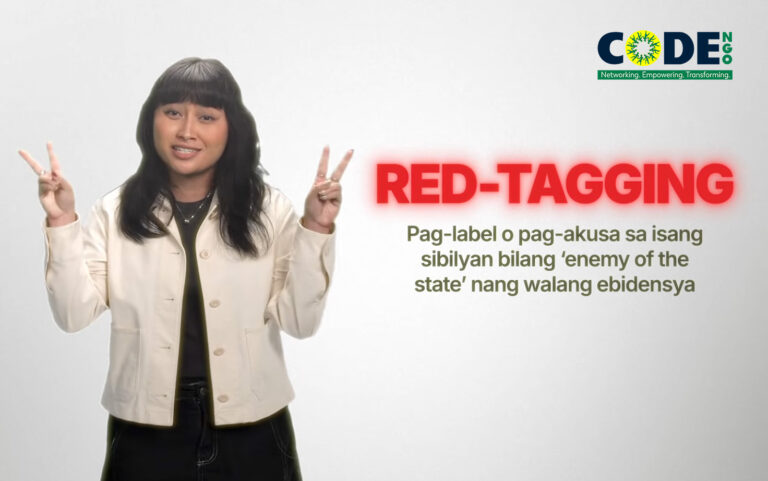
Gaano kadelikado ang red-tagging? | CODE-NGO Explainer
When speaking up on issues affecting our communities leads to being labeled as an enemy of the state, the line between advocate and combatant blurs.